

Hiking
Monte Torre Maggiore – the archaeological hike
This is the walk for anyone who likes a payoff at the top that isn’t just a view. Monte Torre Maggiore, at 1,120 metres the highest peak of the Terni mountains, carries the remains of two ancient temples on its summit – and the climb passes a 12th-century Romanesque church inside pre-Roman walls on the way (Vivi Terni).
Photo: ImagoAnimae, Wikimedia Commons, CC BY-SA 3.0
Facts checked: October 2026. The best “ruins-and-a-view” walk near us – a pre-Roman temple on a 1,120-metre summit above Cesi. A proper half-day among ancient stones, with a real view as the payoff.
What’s up there
Excavations on the summit uncovered two temple sanctuaries – one dated to the 6th century BC, the other to the 2nd-1st century BC – marking the mountain as a place of worship for the ancient peoples of the area, with a travertine threshold to the sacred enclosure. Digs here produced a remarkable series of votive bronze statuettes of stylised figures, now shown in the Archaeological Museum of Terni (worth pairing with the walk). It’s a genuinely unusual thing to stand among at altitude.
A gilded bronze thunderbolt found among the offerings suggests the sanctuary was dedicated to Jupiter the Lightning-Thrower (Iuppiter Fulgurator). The memory lingered in later names for the summit, “Ara Maior” and “Monte Peracle” (Umbria Tourism).
The route — the honest version
The classic approach starts from Cesi (a village on the edge of the Terni plain), on a marked trail that climbs past the church of Sant’Onofrio to the Sant’Erasmo plateau, with its pre-Roman walls and 12th-century Romanesque church and continues up to the summit. Italia.it rates the loop from Cesi difficult, a full day’s outing. It’s a proper half- to full-day mountain hike with real ascent – not a stroll – so allow plenty of time, carry water, and start early in summer.
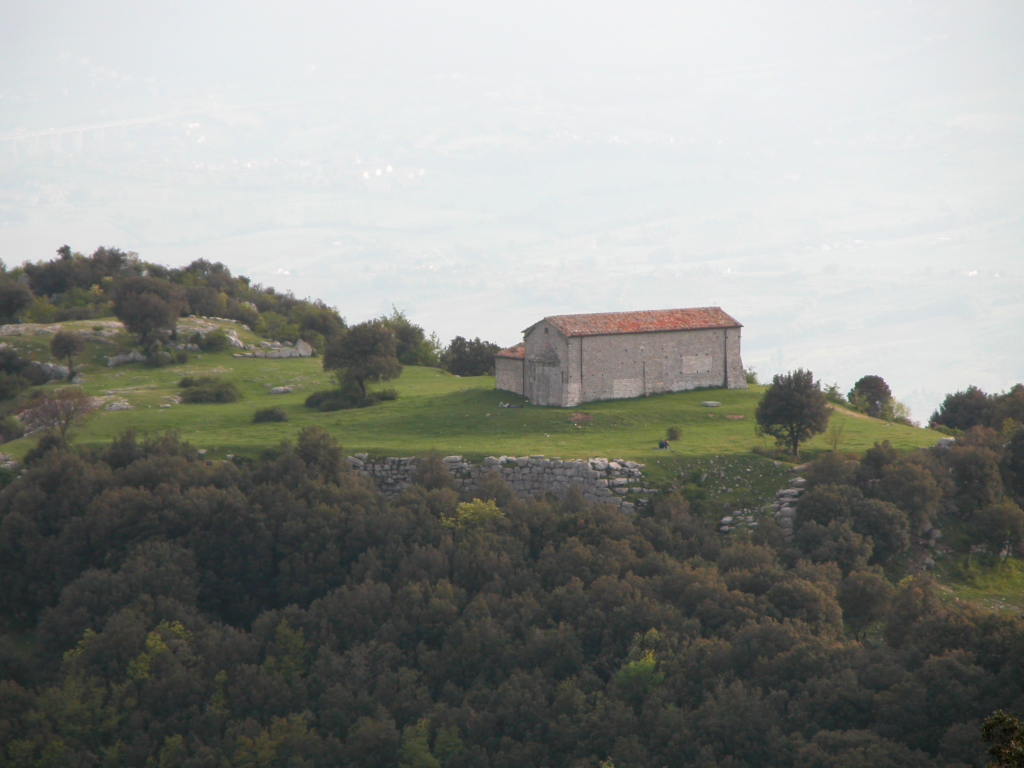
The Sant’Erasmo plateau halfway up is worth a proper pause. Two original gateways still open through its polygonal walls, built by the early Umbrians, and the view reaches the Terminillo and, on a clear day, Monte Soratte (italia.it).
Suitability
Better for older children and up – there’s sustained climbing and exposed summit ground. Solid footwear, plenty of water (assume none on the mountain), and an early start in summer.
Combine it
The mountain sits above Cesi and near Carsulae – so a temple-hike morning and a Roman-town afternoon make a strong archaeology day. Roman southern Umbria → · Carsulae →
Frequently asked questions
What’s on top of Monte Torre Maggiore?
The remains of two ancient temples – one from the 6th century BC, one from the 2nd-1st century BC – on the 1,120-metre summit above Cesi. Votive bronzes found there are in Terni’s archaeological museum.
How hard is the Monte Torre Maggiore hike?
Italia.it rates it difficult and a full-day outing, climbing from Cesi past Sant’Erasmo to the summit.