

Plan Your Trip
Getting here
The falls area sits in Umbria’s bottom corner, which is bad news for its fame and excellent news for you: it’s the closest piece of green Umbria to Rome. Here’s every route in, ranked by how much you’ll enjoy it – and the honest answer to the car question, up front: yes, you want one.
Photo: Mentnafunangann, Wikimedia Commons, CC BY-SA 3.0
Facts checked: October 2026. Fares and timetables drift – the official links below are the source of truth at booking time.
By car (the right answer)
| From | Route | Time |
|---|---|---|
| Rome (city) | A1 north → RA Terni spur / SS3 | ~1h20–1h40 (about 115 km) |
| Rome Fiumicino (FCO) | GRA → A1 | ~1h40–1h50 |
| Rome Ciampino (CIA) | A1 | ~1h25–1h35 |
| Perugia airport (PEG) | E45 | ~1h15 – the underrated arrival (Ryanair UK/EU routes) |
| Florence | A1 | ~2h15–2h30 |
| Naples | A1 | ~3h |
Hire at the airports (all majors) or – the clever pattern for Rome-first trips – train to Terni and collect there (Hertz and Avis in town): the Rome + Umbria plan explains why. Navigation note for the final approach: satnavs get creative in the village lanes – our location page carries the last-500-metres photo guide.

By train (workable, with a plan)
Terni is the railhead: on the Rome–Ancona line with around 14 direct regionals a day from Roma Termini/Tiburtina (65–75 minutes for most, from about €9 – check Trenitalia). From Terni station:
- To the falls: the Marmore Link – one integrated Trenitalia ticket covering train + connecting bus (line 7/E621, ~every 30 min, ~20 min ride). The best carless trick in the area.
- To Piediluco/valley villages: the E624 bus (timetables) – a commuter service, thin on Sundays; plan around it rather than with it.
- Taxi: Radio Taxi Terni, +39 0744 300170 – ~15–20 minutes to the falls/villages; agree the fare first.
The tiny Marmore halt near the falls’ upper entrance has a limited service on the Terni–Rieti line – handy for the Upper entrance, though the bus runs more often. Line note: the Rome–Ancona corridor has a multi-year upgrade programme – spring 2026’s closures didn’t touch the Rome–Terni stretch, but check Trenitalia’s planned-works page before weekend travel.
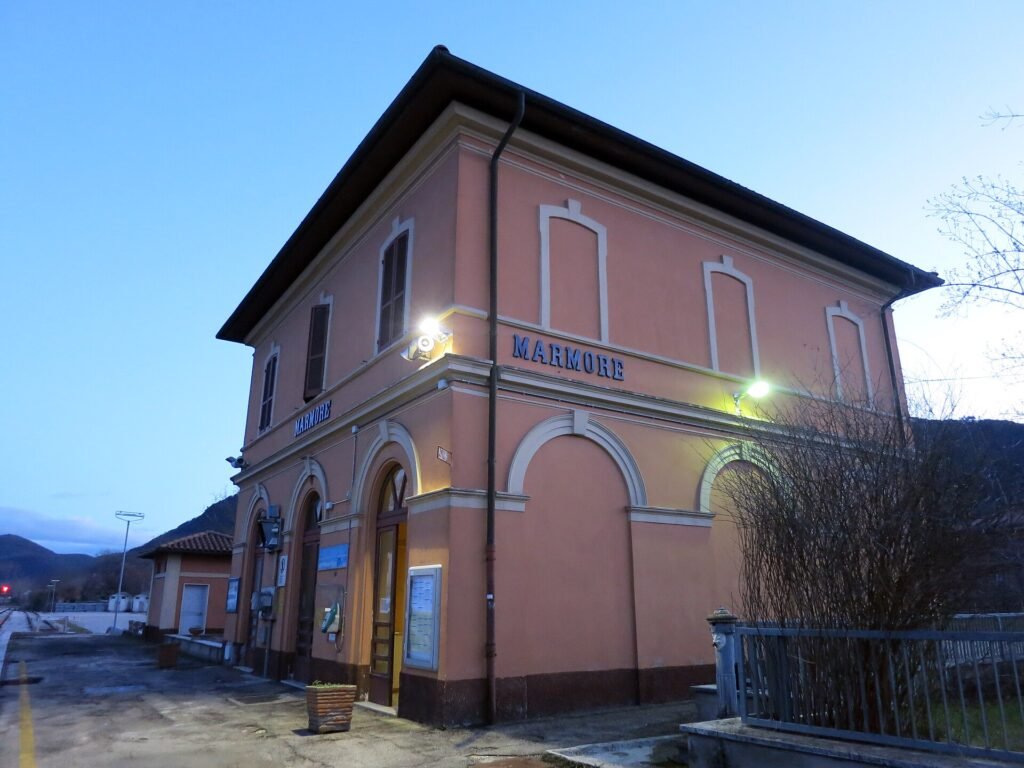
The Marmore Link bus leaves from Terni’s bus station on Piazzale della Rivoluzione Francese, 150 metres to the left as you come out of the railway station, and the bus leg costs €1.30 on top of the train fare (Trenitalia).
The lake has its own integrated ticket, the Piediluco Link: buses run from the same bus station roughly hourly, timed to the trains, for €2.50 on top of the train fare. On Trenitalia, search for “Lago di Piediluco” as your destination (Trenitalia).
The car question, answered plainly
Every attraction in our guides sits 5–40 minutes’ drive from the falls; public transport here exists for commuters, not sightseers. Carless visitors can genuinely do: the falls (Marmore Link), Narni and Spoleto (rail) – the full honest list is Umbria without a car. Everything else – the lake at sunset, the valley villages, Castelluccio, the truffle lunch – wants wheels. EV drivers: charging clusters in Terni, and the villa has its own charger – rare enough locally to plan around.
Frequently asked questions
What’s the nearest airport to Marmore Falls?
Perugia (~75 min) is nearest but thin on routes; Rome Ciampino (~1h30) and Fiumicino (~1h45) carry the traffic. For most UK/US visitors Rome wins on fares and the Rome-first itinerary it enables.
Can you get to Marmore Falls by public transport?
Yes – the Marmore Link integrated train+bus ticket from Rome via Terni, ~2–2.5 hours door to door. Time it around the release windows.
Is driving here difficult?
The autostrada and valley roads are easy; the last kilometres are hairpins and narrow village lanes – normal rural Italy. Drive small (book a compact), park where we tell you, and you’ll be fine.