
Marmore Falls
Facts checked: July 2026. Sources listed at the foot of the page.
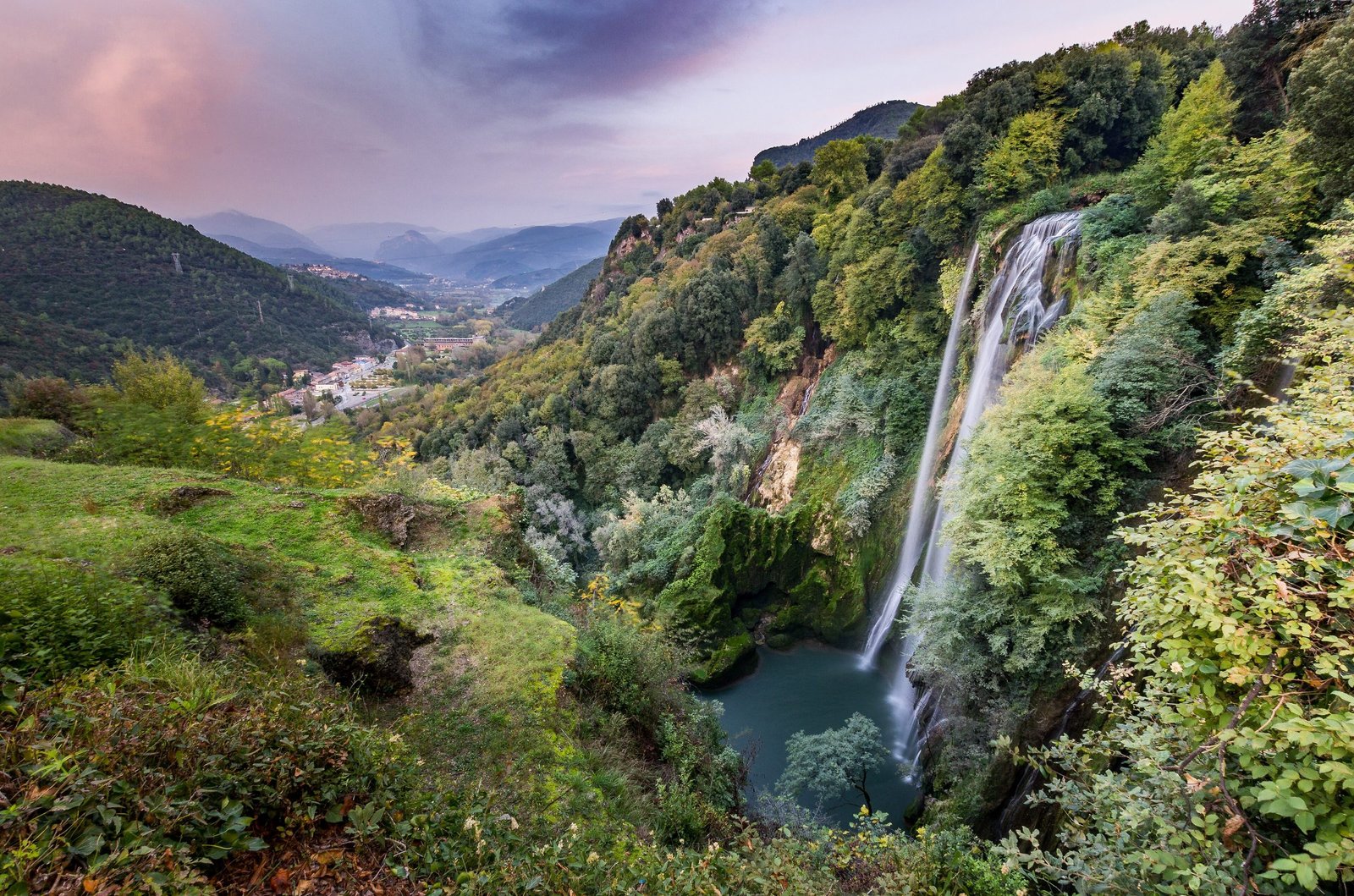
Marmore Falls is not natural. It is a 2,300-year-old piece of civil engineering that Rome built, popes and city-states fought over, poets canonised and a power company eventually put on a timetable. It might be the most argued-about waterfall in history – and the arguing is the good bit.
271 BC — the consul and the marsh
The problem was the Rieti plain: the River Velino pooled there into stagnant, malarial marshland. In 271 BC the Roman consul Manius Curius Dentatus – the general who’d beaten Pyrrhus – ordered a channel cut through the rock at Marmore, draining the Velino over the 165-metre cliff into the River Nera below. The channel is still called the Cava Curiana, the Curiano Trench. It solved Rieti’s problem by giving it to Terni: when the Velino ran high, the Nera valley flooded.
Two thousand years of the water wars
What followed is a very Italian saga: Rieti (upstream, wants the water gone) versus Terni (downstream, doesn’t want drowning) – argued before the Roman Senate itself, then re-litigated for centuries. The trench silted, the marshes returned, and successive authorities cut new channels: notably a second cut in the 15th century and further papal works in the 16th, under engineers sent by the popes – Antonio da Sangallo the Younger among the names attached to the works – until 1787, when architect Andrea Vici’s final adjustment to the lowest drop gave the falls essentially the form you see today.
The Grand Tour makes it famous
By the 18th and 19th centuries the falls were a fixture of the Grand Tour. Corot painted the gorge below; and Byron, in Childe Harold’s Pilgrimage, gave the falls their most quoted lines – the “horribly beautiful” cataract, “a matchless cataract”. The Lovers’ Balcony has its own legend attached – the nymph Nera, a shepherd named Velino, and a jealousy of the gods that ended with him leaping after her; the two rivers meeting at the foot of the falls are, the story insists, the couple finally together. Tell it on the balcony; the spray helps.
The industrial age — the falls get an off-switch
Terni became “the Manchester of Italy” precisely because of this water. From the late 19th century the drop powered the city’s steelworks, and the Galleto hydroelectric plant (1929) put the Velino to work at industrial scale – around 530 MW of capacity. From then on the waterfall became a scheduled event: the water earns its living in the turbines and performs for visitors in published windows. That’s the whole story behind the release timetable – the thing every disappointed review misunderstands. We tell the wider industrial story – steel, cinema and the plant itself – in Industrial Terni.
Today
The falls sell roughly half a million tickets a year, making them Umbria’s most visited paid natural attraction – a 2,300-year-old drainage project outperforming most of Italy’s museums. Curius Dentatus would have invoiced somebody.
Frequently asked questions
Is Marmore Falls man-made?
Yes – created in 271 BC by a Roman drainage channel and re-engineered several times since, most recently in 1787. It’s the tallest man-made waterfall in Europe.
Why does it have a timetable?
Because since 1929 the water primarily drives the Galleto hydroelectric plant; scheduled tourist releases send it over the falls instead. Engineering first, spectacle second – as it has been for 2,300 years.
How tall is it?
165 metres in three tiers – the Velino falling into the Nera gorge.
Sources & further reading
The official park site (Italian); the Umbria tourism board; Wikipedia’s referenced article for the engineering chronology; and for the industrial chapter, our own Industrial Terni deep-dive.