
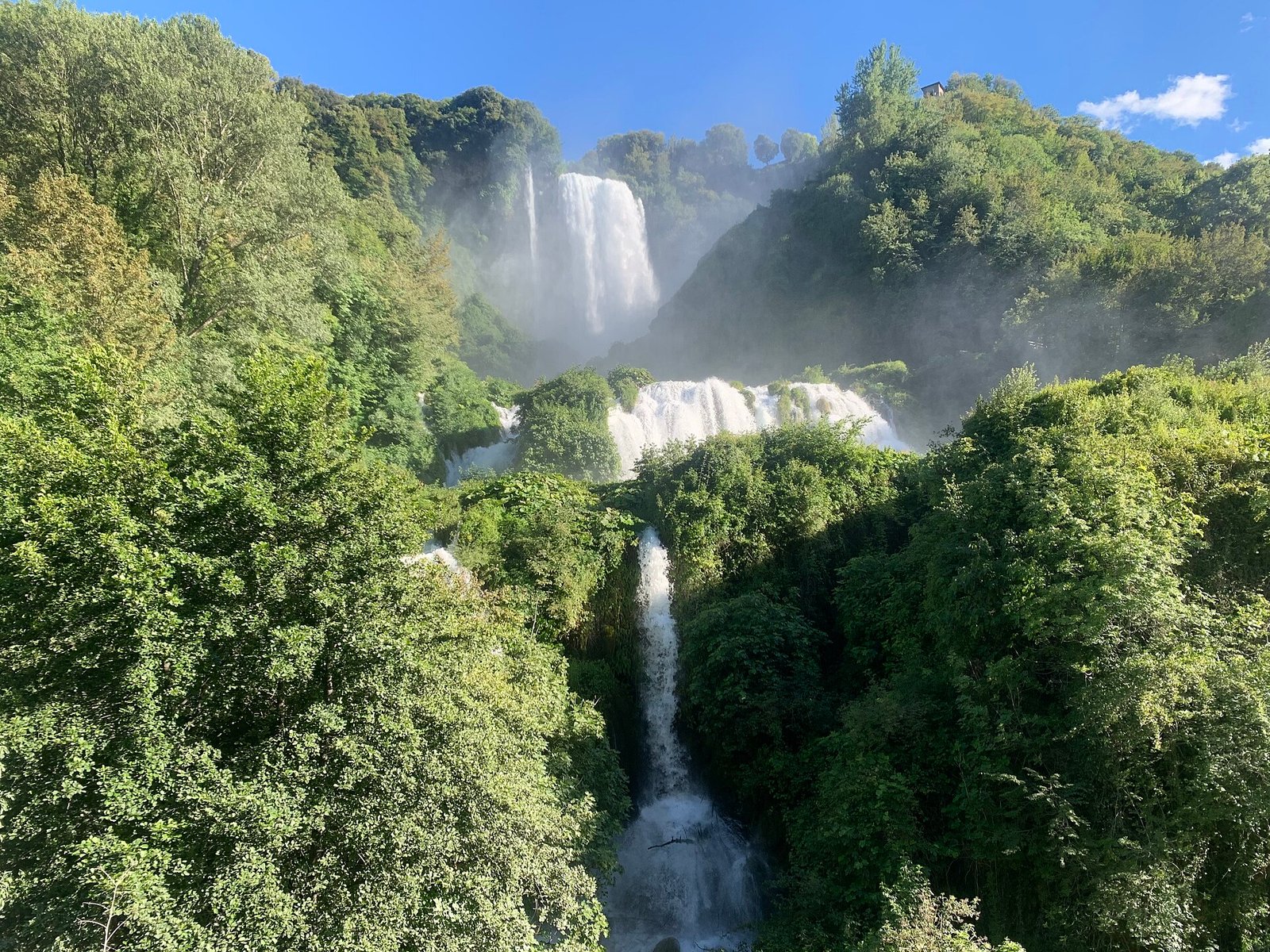
Marmore Falls
Marmore Falls – the complete visitor guide
Marmore Falls – the Cascata delle Marmore – is a 165-metre waterfall that the Romans built in 271 BC, and it has one habit that catches almost every visitor out: it gets switched on and off to a timetable. Arrive in the wrong hour and you’ll watch a trickle. Arrive as the sluices open and you’ll see the most powerful moment in Umbria.
Facts checked: July 2026 · Written by James, who lives in Collestatte, the village directly above the falls.
We live in the hamlet directly above it, so this guide covers what the brochures don’t: when the water is actually on, which of the two entrances to drive to, which trail suits you, and how to build a proper day around it.
Marmore Falls at a glance
The five things to know before you come
The falls are switched on to a timetable — arrive in the wrong hour and you’ll watch a trickle. Read the current water release times before you plan anything else about your day.
- Check the water release times first. The falls run to a published monthly schedule – typically midday and late afternoon on quiet days, much longer at weekends and holidays, with some winter weekdays having no release at all. We keep the current month’s timetable in English here – it’s the page to read before anything else.
- There are two entrances, a 10-minute drive apart. The Belvedere Inferiore (lower) looks up at the full 165 metres; the Belvedere Superiore (upper) stands on the lip. Pick before you drive – our parking and entrances guide explains which suits you.
- Tickets are €12 for adults (2026), children 5–9 and over-70s €10, under-5s free – and buying online skips a queue that gets serious in summer. Details and current prices here.
- You will get wet at the Lovers’ Balcony – book it. The balcony that puts you inside the spray is now a guided visit with limited places (€3.50 on top of entry). It’s the best thing here – reserve a slot when you buy tickets, and bring a poncho. All six paths compared in the trails guide.
- It’s busier than you think. The falls sell roughly half a million tickets a year; Easter Monday 2026 alone saw over 7,000 people, and August peak days pass 10,000. Mornings and shoulder months are dramatically calmer.
What it actually is
The falls are man-made – the tallest man-made waterfall in Europe. In 271 BC the Roman consul Manius Curius Dentatus had a channel cut – the Curiano Trench – to drain the stagnant marshes of the Rieti plain over the cliff edge at Marmore, sending the River Velino crashing 165 metres in three tiers into the River Nera below. Rome and the towns of the valley then argued about the water for the best part of two thousand years. Today the flow belongs to the Galleto hydroelectric plant, which is why the falls run to a timetable at all – the full story is in our history page.
Planning your visit
How long do you need?
Two to four hours covers the trails and both viewpoints comfortably. Add a half day if you’re rafting underneath it – which you can, and should, if anyone in your group has the appetite: rafting and canyoning guide.
When to come
June to August is peak, with evening releases and illuminations on summer Saturdays – magical, and busy. September is the local secret: full summer weather, fraction of the crowds. Winter visits work if you plan around the reduced timetable – and the Christmas illuminations in December are genuinely worth the trip. The area even has a February season, because Terni is St Valentine’s home town – see the romantic playbook.
Getting here
We’re 75-90 minutes from Rome by car, and the falls are a workable day trip by train + bus via Terni – the honest step-by-step, including whether a guided tour is worth it, is in Marmore Falls from Rome. Coming with children? Read the family guide first – one of the trails is essentially 600 steps.
Beyond the falls
Most of the half-million visitors see the waterfall and drive away, which is their loss. Ten minutes up the hill, Lake Piediluco has lakefront fish restaurants and boat trips; the Valnerina – our valley – runs north through medieval villages to Italy’s black-truffle heartland; and horses ride out beneath the falls from the next hamlet over. If you’re building a fuller trip, start with the falls weekend itinerary.
The ValnerinaOur valley — villages, truffles, the mummies, river sports
The falls weekendTwo days built around the water timetable
Stay with us
The villa, above the falls
Palazzetto Manassei — our Art Nouveau villa on the Collestatte piazza. Three bedrooms, a terrace over the gorge, and Marmore Falls a ten-minute walk downhill.
Frequently asked questions
When is the water on at Marmore Falls?
It changes monthly. As a rule of thumb: around midday and late afternoon on off-season weekdays, extended hours at weekends and holidays, and evening releases on summer Saturdays. Always check the current timetable – it’s the difference between a trickle and the full show.
Is Marmore Falls worth visiting?
At full release, emphatically yes – there is nothing else like it within reach of Rome. At no release, no. That’s why the timetable page exists.
Can you swim at Marmore Falls?
No – it’s forbidden and genuinely dangerous. The nearest real swimming is at Lake Piediluco’s authorised beaches, 12 minutes away – here’s where you can swim.
Is it man-made?
Yes – built by Roman engineers in 271 BC and re-engineered several times since. It’s the tallest man-made waterfall in Europe.
Useful official links
The official falls website (Italian – tickets, timetable, rules), the Umbria tourism board’s English page, and the Comune di Terni’s Vivi Terni portal. For everything they don’t cover in English – the monthly timetable, the entrance question, the honest trail comparison – that’s what this site is for.